As any senior will tell you, college application season is chaotic; Seniors are expected to write college essays (usually several), request recommendation letters, and research which colleges they’re actually applying to in the span of about six months. As for me, applying for college was especially hectic—as a Questbridge Scholar, I ranked and submitted ten college applications in the span of just 3 months. As a result, I regrettably did little research about these colleges outside of their acceptance rates and prestige. Fortunately for me, the college I ended up getting accepted to, Claremont McKenna College, would grow to be my favorite, largely because of its unique history and personality.
Claremont McKenna College is one of five Claremont undergraduate colleges in the Claremont Consortium, informally known as the 5Cs. The 5Cs average out to have a 15.6% acceptance rate and house roughly 5,000 students. The first college of the 5Cs is Pomona College, founded by James Blaisdell. Blaisdell envisioned Pomona College to offer the specialization and personal community of small colleges while simultaneously providing students with the resources of large universities. However, Blaisdell was met with a problem—as Pomona College grew in student population, they received more funding and land. Although this sounds good on the surface, it undermined Blaisdell’s vision of Pomona being a small college. Blaisdell was faced with two choices: Continue growing Pomona College, turning it into a university instead of a small college, or decline Pomona’s funding and land. Blaisdell chose neither, and developed a whole new option; In his letter to Ellen Browning Scripps (who would later co-found the second member of the 5Cs—Scripps College), Blaisdell wrote the following:
“I cannot but believe that we shall need here in the South [of California] a suburban educational institution of the range of Stanford. My own very deep hope is that instead of one great undifferentiated university, we might have a group of institutions divided into small colleges—somewhat on the Oxford type—around a library and other utilities which they would use in common. In this way I should hope to preserve the inestimable personal values of the small college while securing the facilities of the great university. Such a development would be a new and wonderful contribution to American education. Now the thing which would assure this future institution to Southern California is land … It is now or never.”
Apart from Blaisdell’s letter being cold as heck, his vision for the future Claremont Colleges has largely fulfilled itself; 5C students can cross-register for classes at any of the five colleges, share libraries, dining halls, and facilities, and even access internship pipelines and research programs across the consortium—that is the uniqueness I was referring to in my introduction that spiked my interest for Claremont McKenna College. Today, each college in the 5Cs have their own distinct personalities consisting of their political outlooks, major and program specialties, and architecture of the colleges themselves. In the rest of this article, I will briefly go over the personalities of each college in the Claremont Consortium.
POMONA COLLEGE

Starting with the founding member, Pomona is often ranked among the top liberal arts colleges in the nation. Pomona can be described as a pretty traditional liberal arts school, focusing on a more well-rounded education and placing emphasis on subjects like the humanities and philosophy.
Kaden’s Fun Fact: Pomona celebrates April the 7th, after a professor jokingly proved the number 47 occurs more in the natural world than any other number. Now the number 47 is hidden in campus architecture and even gets featured in Hollywood TV scripts from their alumni.
Kaden’s Statistic: Pomona ranks #2 most diverse student body in America according to Niche. Pomona’s massive endowment in proportion to its undergraduate class allows for Pomona to recruit globally.
SCRIPPS COLLEGE
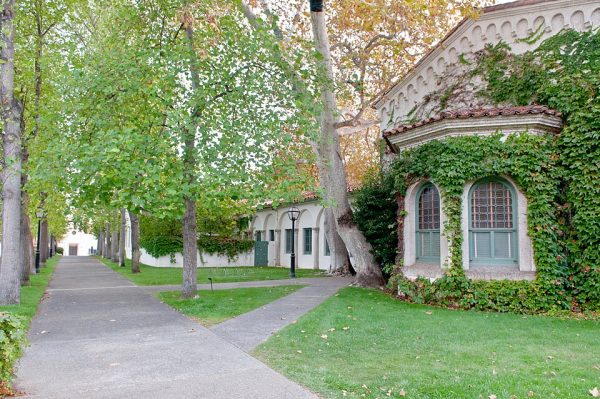
As foreshadowed in the second paragraph of this article, Scripps is the second member of the Claremont Consortium, and the only all women’s college of the five. At the time of its founding, many elite colleges at the time were men’s only colleges. Scripps was founded to offer women a rigorous and prestigious education.
Kaden’s Fun Fact: In 1934, undergraduates from Scripps wanted a grass section on campus so badly that they voluntarily skipped dessert so Scripps could divert the funds to buying grass seed.
Kaden’s Statistic: Scripps ranks #2 best college food in California according to Niche. They’re highly praised for their food variety and high-class food presentation.
CLAREMONT MCKENNA COLLEGE

Next is my personal favorite and the third member of the 5Cs. Established right after WWII, Claremont McKenna aimed to help returning soldiers find higher education. In contrast to other liberal arts colleges, Claremont McKenna placed a heavy emphasis on the application of college education in the job market, focusing on subjects like Government and Business. Roughly 90% of students secure internships, with a median mid-career salary of $155,000. An internship from Claremont McKenna allows students to intern on Capitol Hill, so it’s possible for students to be working for or in direct contact with their congressmembers. One of Claremont McKenna’s distinguishing features is its Open Academy, an institutional initiative to foster open-minded and constructive dialogue. Because of this, the student population is very diverse in its political views, holding an equal distribution of conservative, moderate, and liberal students. With the mindset of the Open academy, CMC’s debate team has gone on to rank in the nation’s top ten for 24 out of 29 years.

(Tech. Sgt. Andy Dunaway)
Kaden’s Fun Fact: Claremont McKenna’s students engage in a massive, coordinated food fight at midnight to relieve stress during finals, nicknamed “The Spaghetti Night.”
Kaden’s Statistic: Claremont McKenna’s student body ranks #1 in America for friendliness and #2 in America for political activity according to the Princeton Review. They also rank #1 for happiest college in America according to Newsweek.
HARVEY MUDD COLLEGE

Then there is Harvey Mudd. After the Soviet Union launched Sputnik, America realized it needed trained engineers, and Mudd was a direct solution to that. Today, Mudd is the STEM powerhouse of the consortium, consistently ranking as one of the top engineering and computer science colleges in the nation. Not only that, its graduates often earn the highest mid-career salaries of any college nationally—roughly $165,000. While Harvey Mudd is a strict, stem-based college, their students’ Honor Code allows for their students to take exams completely unproctored. This means that students can take exams in their dorms or wherever they please since the faculty trusts their students so much.
Kaden’s Fun Fact: Because Harvey Mudd’s campus is so flat, its unicycling culture has grown so much that seeing students unicycling to class has become a normal part of the college’s culture.
Kaden’s Statistic: Mudd ranks #2 in America for career placement according to the Princeton Review. They also rank #1 in the nation for return on investment according to Forbes despite having one of the highest tuitions in the country—about $96,000 a year. Harvey Mudd graduates gain a net worth of roughly 4.5 million dollars over the span of 40 years, beating MIT, Princeton, and UPenn.
PITZER COLLEGE

Last but not least, Pitzer. Pitzer was established in the heart of the Civil Rights Movement, and its founding philosophy mirrored that era’s questioning of tradition. Because of this, Pitzer is the most progressive and socially conscious of the 5Cs, with its curriculum built around social justice, environmental studies, and community engagement. Murals can be seen around campus that reflect this social attitude. Pitzer is known for its lack of traditional requirements, giving students unusual freedom to build their own academic paths.

Kaden’s Fun Fact: On Pitzer’s campus, there is a massive outdoor concrete wall where students can paint whatever they want at any time—This constantly evolving mural mirrors the college’s philosophy in progressive political attitudes.
Kaden’s Statistic: Pitzer ranks #4 in student experience according to the Wall Street Journal.
CONCLUSION


Admittedly, when I got accepted to CMC I was kind of disappointed. Its name doesn’t come with the same recognition as other colleges, like UCLA or Stanford. However, after experiencing the Spring Student Orientation, I truly believe that this college is the best place for me moving forward because of all the reasons I’ve listed thus far.
I originally wrote this article because I wanted more people to know about these hidden gems, but seeing the diversity between these five colleges alone exemplifies just how many different colleges there are out there. Now, I hope this article serves as encouragement to deeply research colleges—beyond just acceptance rates and prestige. This doesn’t have to be exhausting, it could simply look like watching student vlogs on YouTube. Every college—especially small ones—maintains a character unique to itself, so out of all the colleges in the world, one of them will be right for you. Please go find it!